
Description of Maxon CINEMA 4D Studio 2027.0:

Maxon CINEMA 4D Studio 2027.0 Pre-Activated is the perfect package for all 3D artists who want to achieve incredible results quickly and effortlessly. Beginners and seasoned professionals can quickly achieve incredible results using Cinema 4D’s tools and features. The legendary reliability of Cinema 4D also makes it ideal for high-speed 3D productions. Its fast, powerful, flexible, and stable tools make 3D workflows more accessible and efficient for design, motion graphics, visual effects, AR/MR/VR, game development, and technical professional visualization.
Maxon CINEMA 4D Studio Full Version character tools make it easy to create character outfits and progressive character simulations. Adding hair or fur to characters is quick and modest with an influential suite of hair tools that allow you to grow, comb, style, and animate. The physics engine makes it possible to perform compound crashes and collisions among objects, whether just a few or thousands. Network rendering permits you to benefit from all the PCs on your network to help render your animations quicker.
Cinema 4D Studio 2027.0 Key Benefits:
-
Easier More Realistic
Maxon CINEMA 4D Studio Crack makes the easiest-to-use professional 3D software more competent than ever before. Novel tools, in addition to extended and revised features, help you turn your thoughts into reality even faster and with less effort. The enhanced workflow helps you meet the tightest deadlines. We’ve even gone so far as to reinvent the line!
-
Work Fast, Play More
Smooth workflows bring originality to life. That’s why the workflow is opposite and centered on Maxon CINEMA 4D Studio Patch. The innovative Take System will save valuable time. The novel Color Selector does all those things you always wanted with color, in addition to things you didn’t even know you wanted! Integration with SketchUp and the Houdini Engine makes Cinema 4D your ideal hub.
-
Onboard spline tools with real-time feedback
Maxon CINEMA 4D Studio’s Latest Version comes with a comprehensive spline toolkit – no need to switch to an external tool. Simply produce and adjust splines with Cinema 4D’s new Pen tool, drawing, smoothing, arc tool, and Boolean commands.
-
Intuitive and efficient organic modeling
Dozens of new features and enhancements in Maxon CINEMA 4D Studio make shaping a true pleasure. Utilize Sculpt to PoseMorph, for example, to speed up character animation. Simply sculpt hard-surface models with Edge Detection.
-
Better variability & usability
Maxon CINEMA 4D Studio provides novel and extended shaders to increase usability and presentation. Through the novel Material Override function, you can effortlessly override the exact channels of nominated materials to make clay or matte renders.
-
Stability
The stability of Maxon CINEMA 4D Studio is well-known in the 3D community and beyond. All new features and functions are fully controlled by QA and our beta testers before release. Our free update package, which is published periodically, further optimizes Cinema 4D and responds quickly to changes in the operating system and drivers!
-
Powerful Help System
You can quickly answer any questions about specific features by right-clicking and going directly to the documentation for the integrated software.
-
Procedural Workflows
Be flexible from start to finish! Staying flexible to make last-minute changes is important no matter what project you’re working on. Maxon CINEMA 4D Studio offers a host of non-destructive features: parametric modeling, procedural shading, textures, and more. The Cinema 4D Take System allows you to store and manage multiple versions of scenes in one file!
Cinema 4D Studio 2027.0 Key Features:
- Modeling: Introducing ZRemesher for retopology, new interactive modeling tools, enhanced spline nodes, new capsule capabilities, and improved vector import.
- Cloth Simulation: With all-new Fabric and Strap dynamics, you can achieve more realistic simulations on multi-threaded CPUs or GPUs.
- Redshift Everywhere: Redshift for Cinema 4D now supports CPU rendering and includes high-quality preview in the viewport and import/export of Redshift content.
- Capture 3D models with Moves by Maxon: Quickly convert a series of images into 3D models in Cinema 4D.
- Track Modifier Tag: Allows you to change the animated tracks on objects or beacons quickly.
- User Interface Enhancements: The most intuitive 3D app just got better. The modern C4D interface shows you what’s important and focuses more on your work.
- Capsules: Capsule assets built into the core of C4D scene nodes provide plug-in-like procedural capabilities.
- Spline import: Import vector images from Illustrator, PDF, and SVG files to use in your 3D scenes. Advanced features are supported, such as symbols and shapes filled with gradients.
- Polygonal Modeling: Polygons are 3D building blocks. With Cinema 4D’s comprehensive set of polygon modeling tools, it’s easy to create everything from cars to creatures.
- Parametric Modeling: Maxon CINEMA 4D Studio offers a variety of parametric objects that give you a structure to build and give you the flexibility to make changes at any time.
- Volume Modeling: Volume modeling based on OpenVDB in Cinema 4D provides a procedural way to create complex objects by combining basic shapes in Boolean operations.
- Sculpting: Create organic models with Cinema 4D’s intuitive sculpting tools. Drag, smooth, flatten, crop, compress, etc. Your stitches are like digital clay.
- Poly pen: This is the Swiss Army knife for 3D modeling. Easily create, select, move, or delete points, edges, and surfaces without changing tools.
- Polygon Reduction: Reducing polygons quickly reduces the number of polygons in a model while maintaining smooth UVs, point maps, and light mesh selections.
- Texturing: The Cinema 4D material system allows you to create photorealistic materials with layered material channels, reflectance, procedural shaders, and more.
- Node-based Materials: Create complex materials for Maxon’s physical renderer. Intuitive, flexible, and powerful, as you would expect from a node-based system.
- BodyPaint 3D: BodyPaint 3D has a complete set of tools for painting detailed textures directly onto your 3D objects, turning models into beautiful works of art.
- UVs: Maxon CINEMA 4D Studio provides everything you need to make working with UV a pleasure, whether it’s solid surfaces or organic shapes.
- Animation Basics: Almost any object, material, or parameter can be animated. You can create keyframes manually, with automatic or parametric keyframes.
- Character Animation: Maxon CINEMA 4D Studio offers a variety of powerful and easy-to-use animation tools to help you create and bring characters and creatures to life.
- Fields System: By far the most powerful feature in MoGraph, and more than just mitigation. A new way to control, layer, and link effects to each other.
- Magic Bullet Looks: Easily apply any of over 200 predefined movie views, import LUTs, or work with custom color grading tools – right in C4D.
- Car Rig: Whether you’re animating your car for advertising or visual effects, these powerful and intuitive Car Rig presets help you easily prepare your car for a powerful glide.
- Simulation: Create dynamic relationships between objects, create hair and fabrics, or use springs, motors, and aerodynamics to create impressive simulations.
- Lighting in C4D: Exposure controls, including Color, Brightness, Dim, Visible or Volumetric Light, Noise, and Lumens or Candela Brightness, deliver real results.
- Tracking objects or camera positions is necessary to integrate 3D elements into the footage. C4D offers built-in tools to achieve this.
- Character Object: Allows you to easily create flexible rigs for all types of characters based on presets for bipeds, quadrupeds, and other animals created by top animators.
- Mixamo Control Rig: Easily apply animated clips from the Adobe Mixamo library to your Cinema 4D characters and transform or repurpose them in a few simple steps.
- Toon Rig: Animation as in Looney Tunes. This versatile character pack offers all the features you need to bring cartoon style to life.
- Rendering system: With elegantly realistic rendering and easy infrastructure management, Cinema 4D has everything you need for a smooth rendering workflow.
- Moving by Maxon: Capture facial and body movements with our iPhone and iPad apps and instantly apply them to your character in Cinema 4D.
- Substance: The Substance plugin for C4D offers built-in 3D content creator support for Allegorithmic procedural material workflows in C4D.
- Voronoi Fracturing: The Voronoi Fault allows you to break any object into procedural fragments, using just about anything to control the distribution of the fragments.
- Take System: Edit and save almost any settings in Cinema 4D – object properties, animation, lighting, camera, materials, textures, and more.
- After Effects Integration: Cineware Maxon lets you insert your C4D projects directly into After Effects, manage 3D assets, and render directly from After Effects.
- Adobe Illustrator: Integration with Adobe’s industry-leading vector graphics software allows you to import original vector graphics, fonts, and graphics into Cinema 4D.
- Adobe Photoshop: Tight integration with Adobe industry standards for image processing allows you to import layered PSD files, for example. For easy fabrication.
- Network Rendering: Flexible administration is the key to efficient rendering. The C4D network rendering solution simplifies rendering client administration.
- Supported File Formats: The work environment is rarely homogeneous, and fluidity between tools is essential. C4D supports all common interchange formats.
- SDK / Development Community: In a studio environment, it is often necessary to create tools to integrate C4D into the pipeline. Our well-designed SDK makes this process easy.
- X-Particle Integration: X-Particle is by far the most widely used modeling tool for C4D. From realistic effects to abstract motion graphics, anything is possible.
- Unreal Integration: With the release of Unreal Engine 4.23, Epic Games introduced support for Cinema 4D via the Datasmith plugin.
- Unity Integration: The Unity plugin (available from the Unity Asset Store) is compatible with Cinema 4D R21+ and Unity 2019.3.0+.
- Vectorworks Integration: Vectorworks develops versatile design and BIM software for the architectural, landscaping, and entertainment industries.
- Archicad Integration: ARCHICAD is a leading provider of Building Information Modeling (BIM) software solutions for architecture and design.
- Allplan Integration: ALLPLAN is a global developer of open building information modeling (BIM) solutions.
- Sketchfab Integration: With the free Sketchfab plugin, you can upload 3D objects and animations directly from Cinema 4D to the Sketchfab platform.
- Environment: Creating a terrain model from scratch is hard work, but there are specialized tools that allow you to create a world in an instant.
- Apple Final Cut Pro and Motion: Maxon CINEMA 4D Studio can create layered Final Cut Pro 7 project files with just a few clicks.
- Nuke Integration: Maxon CINEMA 4D Studio can create fully NUKE project files with the correct node structure.
- Blackmagic Fusion Integration: Instantly render Fusion compositions with Cinema 4D.
- Simulation Partners: Whether it’s an impressive simulation of smoke, water, fire, or an abstract particle flow for motion graphics, there’s software for it.
- Rendered with Chaos V-Ray: V-Ray is an award-winning rendering engine for artists, architects, designers, and generalists to render anything you can imagine.
- Rendering with Arnold: Arnold for Cinema 4D provides access to the powerful Autodesk Arnold rendering engine from the standard Cinema 4D interface.
- Rendering with Corona: High-performance (unbiased) photorealistic rendering focused on realism, ease of use, and affordability without sacrificing quality or power.
- Other Renderers: Every artist has their preferences when it comes to rendering. That’s why Cinema 4D supports a wide range of external rendering engines.
- Real-Time Graphics: The key, especially in broadcast production, is the ability to quickly add state-of-the-art graphics. C4D brings 3D objects directly to mainstream applications.
- Motion Capture: Motion capture is an easy way to quickly and realistically animate characters. Cinema 4D supports major mockup device manufacturers.
- Cineware for After Effects: Since 2013, Cineware has been seamlessly integrating Cinema 4D assets into After Effects.
- Cineware for Illustrator: Add and edit 3D objects in real-time in Adobe Illustrator CC 2020 with the new Cineware plug-in for Illustrator.
- Rendering with Octane: OctaneRender is a spectrally correct, unbiased GPU rendering engine with high quality and output speed, popular among C4D artists.
- Placement Tools: Placing objects in a scene has never been easier and more intuitive, whether you’re creating a complex environment or adding greenery to a logo.
- Asset Browser: Easily find and use models, materials, and other assets. An amazing library of resources to support your creativity is always there.
- Scene Manager: New node-based capabilities in Cinema 4D let you use flexible node resources for procedural geometry creation, cloning, and more.
- MoGraph Basics: MoGraph is our unique, award-winning procedural modeling and animation tool that makes C4D the best choice for motion designers.
What’s new in Maxon CINEMA 4D Studio 2027.0?
(Released on 14-10-2026)
New Features
- Scatter Generator & Scatter Tag
A procedural system for populating surfaces with large numbers of instances while keeping artistic control. Distribution modes cover Surface Grid, Area Weighted, UV Grid and Spline Projection, with density maps, relaxation and overlap removal. A scatter can therefore be made genuinely non-overlapping rather than only looking that way. The system is deeply integrated with MoGraph for post-scatter variation and animation.
- Variation randomises everything per instance, including position, rotation, scale and color, alongside alignment to surface normals and Look At targets. Vertex maps give localised control.
- Filters restrict placement by altitude, slope, curvature and distance to mesh boundaries. Each has a Breakup control for natural transitions.
- Clusters group instances into dense regions using a voronoi noise function. Per-object Cluster IDs let different assets appear in different regions.
- Proximity uses splines or other Scatter Generators to mask instances or drive their scale by distance. Typical uses are clearing obstacles, fading density near roads and growing instances around attractors.
- The Scatter Tag sets per-object scatter probability, filtering, transform and cluster assignment.
- Liquid FX
Liquid FX adds spray, foam and bubbles on top of an existing liquid simulation. It brings detail that would otherwise cost a large increase in simulation resolution. Two new objects drive it. The Liquid FX Emitter generates particles procedurally from the simulation’s own estimated quantities, such as trapped air and wave crest. The Liquid FX Modifier converts existing particles directly. Particles respond to the liquid around them and switch type automatically based on their neighbour count. Spray moves by inertia, foam drifts with the surrounding velocity field at a surface offset, and bubbles drift and rise with buoyancy.
- Nodes Field, Nodes Effector and Sample Field Node
The Nodes Field object builds a custom field from a node graph. It is more efficient than the Python Field and more powerful than the Formula Field. The Nodes Effector does the same for MoData, with optional custom strength and selection-weight handling. The new Sample Field node samples a field list from any Scene Nodes setup, batching samples efficiently inside loops. All three offer an Array Mode for advanced setups. Both the Nodes Field and the Nodes Effector are MCP-compatible, so custom fields and effectors can be built with AI assistance.
- Copy/Paste from Cinema 4D into Autograph
Cameras, lights, primitives, planes, text, nulls, and their position, rotation, and scale animation can now be copied from Cinema 4D and pasted into Autograph. Animation is baked per frame, so motion driven by expressions, MoGraph, constraints, or rigs arrives matching viewport playback. Static values are exported as constants. Standard and Redshift cameras and lights are both supported. MoText and Text splines come across as native, editable Autograph text layers, and unsupported objects fall back to nulls.
Workflow and Interface
- Tag Grouping
A new button in the Object Manager collapses an object’s tags into visual groups, without changing tag order. Hovering a group shows how many tags it holds. Clicking opens a list you can select from, drag out of, or close with Esc. Whole groups can be dragged and dropped to reorder tags quickly. The Filter Manager controls which tag types group. Tags that can only exist once, such as Phong, are never grouped.
- Tag Content Preview
Tag contents are now drawn in the viewport without having to make anything editable. Polygon, edge and point selections, vertex maps, vertex colors and soft selections are all supported. It works on procedural selections too, including those on primitives and generators, so you can see what a selection actually covers before anything downstream uses it. Hovering gives the preview inside the tag group list. For a single tag, or with grouping disabled, the tag needs to be selected. A new preference sets the highlight color and its opacity.
- Tool Hints
Selected tools now display a HUD showing how they are used, including modifier keys, mouse buttons and component-mode restrictions. The hints fold and unfold from an arrow in the HUD’s upper left, as a global setting.
- Random Object Color Display Mode
A viewport display mode that draws every object in a different color without overwriting its Display Color, making segmentation in complex scenes readable at a glance. Enabled as “Random Shading” in the Viewport settings (Shift+V) or from the View menu.
- View Occluded Selections
Selected components are now drawn even when hidden behind other polygons of the same mesh or behind another object. A new preference sets the opacity of occluded components, 10% by default and 0% to switch it off. It can also be toggled from the viewport menu or view settings.
- CAD Import
CAD import now runs on WinArm and supports more formats: 3MF/AMF (.3mf, .amf), 3D Experience (.3dxml), CREO (.xpr, .xas, .neu), IFC (.ifc), Inventor (.ipt, .iam), NX (.prt) and Solid Edge (.par, .asm, .psm). These come alongside the existing Catia V5, Open JT, IGES, STEP and SolidWorks support.
- Resample Textures
A new command in the Commander that transfers textures and materials between two objects with completely different UV maps but similar shape. It is built for moving look from a high-poly, bad-topology mesh onto a Remesh generator output, where Transfer Attributes breaks down. It can reproject a new UV map, cubic or angle based, or use an existing one. Resampled textures are written with a resampled_ prefix to a chosen output directory, and copies of the source materials are applied to the target.
- Bend Deformer Strength & Rotation Handles
Strength and rotation are now separate. A draggable band sets the deformation direction, the strength handle moves along that direction, a HUD shows the current angle, Shift quantises to the modeling settings, and rotation is unlimited.
Redshift 2027.0
- Advanced GPU Memory Architecture
A new VRAM management architecture with more granular memory allocation, improved GPU resource sharing with other accelerated applications, better unified-memory support, and parallel scene loading across multiple GPUs. The largest gains are expected on high-memory GPUs, unified-memory architectures and multi-GPU systems.
- Redshift for Cinema 4D performance
Performance work throughout Redshift for Cinema 4D. Time to first pixel and scene updates are both much faster, and the Viewport IPR is noticeably more responsive in day-to-day work.
- Redshift Fur
A procedural system for fur, fibers, woven textiles and knitted materials, generated at render time on any mesh rather than as dedicated geometry. Supports motion blur, instancing, UV controls and Redshift materials.
- Redshift Live enhancements
Faster shader compilation plus new support for refraction, transparent shadows, area light spread and ray-traced depth of field, making Redshift Live a closer representation of the final render.
- NVIDIA RTX Spark support
Redshift workflows extend to NVIDIA RTX Spark devices.
Cinema 4D workflow improvements
- Node Editor drag & drop. Drag a Redshift material into the Redshift Node Editor to create a Reference node linked to it, or a Vertex Color/Vertex Map tag to create a Vertex Attribute node named after the tag, exposing only the valid output port (outColor or outScalar).
- Triplanar Mapping and Hex Tiling in the Material Tag. A Redshift feature exposed through Cinema 4D’s Material Tag, so UV Context settings can be adjusted per object without duplicate materials or projection settings baked into the material. Useful for correcting texture stretching and breaking up visible repetition.
- Auto Focus for the Redshift Camera. Focus adjusts automatically as you navigate the scene.
- Color management. ACES 2 support and more consistent color-space handling, matching the OCIO changes on the Cinema 4D side.
Other smaller Features, Changes and Improvements
- OCIO updated to ACES 2.0.
- The Auto mode of the Bitmap, MoGraph Color and Vertex Map shaders has been removed. Scenes created before 2026.4.0 convert Auto to an explicit mode on import.
- Color space names are now saved in the scene alongside the index, so the index follows the name when the configuration changes.
- The color space list now follows the order of the configuration file instead of sorting alphabetically, so important spaces can be placed at the top.
- Color spaces are grouped by family, with a list of commonly used spaces at the top of the menu. Custom configurations can assign spaces to that category.
- New $take_hierarchy token pastes a take’s full hierarchy, concatenated with underscores, instead of just the take name.
- New $takeparent# token returns the name of a parent take, with # setting how many steps up to go. It returns “unresolved” if no parent exists at that depth.
- “Save All Takes with Assets” now always uses hierarchical take names for target folders, reducing name collisions.
- New interface color for the viewport border when Auto-Take is active.
- Node Editor search now dims wires, notes, rerouters and scaffold as well as nodes, and auto-frames the result.
- Solo display in the material Node Editor dims every node that is not upstream of the solo node and outlines the solo node in thick orange.
- Port Inspector and Data Inspector now work on unconnected ports in Scene Nodes, instead of showing “Not Active”.
- Bridge tool curvature calculation improved, so bridges now appear more circular.
- UV Rectangularize now processes multiple rectangular polygon patches in one run, reporting any islands it could not handle.
Bug Fixes
Animation
- Fixed an issue where Key Reducer creates duplicate keys and broken tangents on Cappucino tracks.
Asset Browser
- Fixed an issue where Asset Browser preview icon seem disappeared when asset previews disabled.
Attribute Manager
- Fixed an issue where Shift-selecting multiple entries in the User Data Manager list does not work.
- Fixed an issue where the Attribute Manager preset dropdown appears empty after saving a default preset.
- Fixed an issue where changing the Rotation Order does not refresh the Attribute Manager.
- Fixed an issue where formulas on multiple selected objects clears the “Mixed” state and produces incorrect random values.
Bodypaint
- Fixed a UV viewport crash in Projection Painting that prevents painted textures from loading correctly.
Camera Objects
- Fixed an issue where the Camera Deformer brush radius displays incorrectly while idle in the viewport.
- Fixed an issue where default editor camera is set to Ocamera instead of Orscamera when using Redshift as render engine.
Character Animation
- Fixed a crash when creating character templates with incorrectly mirrored or duplicate rig component names.
Color Management
- Fixed an issue where Picture Viewer exports with classic OCIO were saved in linear color instead of sRGB.
Deformer
- Fixed an issue where the Bend deformer rotation handle causes angle values to jump unexpectedly.
- Fixed a crash in various object and deformer workflows involving generators, modifiers, and rendering.
- Fixed an issue where the Bend deformer rotation handle does not work correctly in orthographic views.
- Fixed an issue where FFD Deformer “Fit to Parent” does not fully include Plane objects.
Exchange
- Fixed a crash when importing certain USD files containing invalid UV data and N-gons.
FBX
- Fixed a crash that occurs when importing certain FBX files.
Hair
- Fixed an issue where spline-generated Hair objects do not update correctly in the viewport animation.
- Fixed an issue where hairs flicker and fail to follow guides correctly in certain dynamics setups.
- Fixed an issue where the Add Guides tool generates unwanted hair guides on incorrect parts of the geometry.
Help Content
- Fixed an issue where “Show Help” in the Normal Editing menu opens the wrong help page.
Interface
- Fixed an issue where the sculpting subdivide options cogwheel disappears when using “Text under Icon” mode.
- Fixed an issue that causes excessive memory usage followed by crash on scene opening.
- Fixed an issue where the Plant generator is missing from the generator palette.
- Fixed an issue where Cinema 4D opens the main window on the wrong monitor in multi-display setups.
- Fixed an issue where the “Revert to Saved” confirmation dialog offers redundant options.
- Fixed an issue where loading saved parameter data display an incorrect warning message.
- Fixed an issue where palette “Close” and “Undock” commands result in being disabled and broken Viewport.
- Fixed an issue where managers e.g. Material Manager and UV Editor overlap in docked layouts.
- Fixed an issue where Bitmap Bool icon is not greyed out when its associated option was disabled.
- Fixed an issue where the “Fit Image” option is missing from the Picture Viewer.
- Fixed an issue where “Create Script” is available even though the command is unsupported in certain cases.
- Fixed an issue where Window menu icons are missing when using macOS menu bar.
- Fixed an issue where text appears clipped in Treeview dropdown menus.
- Fixed an issue where system date and time settings misalign date widgets calendar headers.
- Fixed an issue on macOS where “Quit Cinema 4D” and “Quit and Free License” menu items appear in wrong order.
Kerning
- Fixed an issue where middle and right-aligned monospace Text objects shift unexpectedly during animation.
Modeling
- Fixed an issue where Plane Cut previews disappear after moving cut line with “Realtime Cut” disabled.
- Fixed an issue where the Symmetry node generates missing polygons and holes in mirrored geometry.
- Fixed an issue where the Loop Cut preview displays incorrectly in perspective view.
- Fixed an issue where LOD levels does not update correctly based on camera distance in the viewport.
- Fixed an issue where Spline Pen auto snapping does not place points at the correct snapped position.
- Fixed an issue where Extrude and related tools respond incorrectly on scaled high-DPI displays in Windows.
- Fixed an issue where Plane Cut move handles cannot be selected in orthographic views.
- Fixed an issue where Measure & Construction updates are delayed until further viewport interaction.
- Fixed an issue where Loop Cut and Path Cut fail on polygons connected to N-gons.
- Fixed an issue where the modeling axis is positioned incorrectly for polygon selections.
- Fixed an issue where snapping behaves incorrectly when a Bevel Deformer is enabled in the scene.
- Fixed an issue where snapping fails on certain 3D scan meshes with invalid geometry.
- Fixed an issue where Undo/ Redo does not work correctly for point edits on loaded Bezier objects.
- Fixed an issue where Soft Selection previews are missing when the edited mesh had an instance in the scene.
- Fixed an issue where Pattern Selection and Phong Break Selection ignores hidden polygons.
- Fixed an issue where Vertex Paint tool continues painting on hidden geometry across paint modes after using Undo.
- Fixed a crash during modeling operations.
- Fixed an issue with“.” shortcut and brush scaling when using Soft Selection or non-paint brushes.
- Fixed an issue where Measure tool does not update in real time when dragging endpoints.
- Fixed a crash when multiple instances reference the same object in Object display mode.
- Fixed an issue where irrelevant Soft Selection parameters remain editable when using Vertex Map falloff mode.
- Fixed a crash with Spline Pen by double-clicking a point.
- Fixed an issue where Path Selection Functions fails to create/update Selection Tags in Edge mode.
- Fixed an issue where Mesh Checker falsely reports some N-gons as non-planar.
- Fixed an issue where Matrix Extrude viewport dragging does not support negative values.
- Fixed an issue with unstable Brush tool size and overly sensitive viewport drag input.
- Fixed an issue where Mesh Check highlight polygon edges as bad polygons instead of affected polygons.
- Fixed a crash when subdividing objects with Vertex Maps and outdated UV data.
- Fixed a crash caused by invalid point data such as NaN or infinite values in Boolean operations.
- Fixed an issue where Symmetry plane flicker in Local Space when mesh was offset from world origin.
MoGraph
- Fixed a crash when opening certain legacy scenes containing unsupported plugin data.
- Fixed an issue where self-referential MoGraph spline setups not evaluated correctly.
- Fixed an issue where “End” parameter in “Step” mode does not remap the distribution of Clones in Cloner.
- Fixed an issue where Matrix objects using spline distribution disappear after toggling viewport visibility.
- Fixed a crash when scrubbing the timeline in certain older scenes.
- Fixed a crash while generating caches for displaced subdivision geometry.
Neutron
- Fixed an issue where changing Memory node group to Loop Carried Value fails.
- Fixed an issue where Instance nodes inside node graphs do not update in real time.
- Fixed an issue where Memory Nodes in Nodes Modifiers do not work correctly across object hierarchies.
- Fixed an issue where Sum Stream and Aggregate nodes display incorrect values in Inspector.
- Fixed an issue where multiple Greeble nodes using same selection are not evaluated correctly across deformers.
- Fixed an issue where Nodes spline generators not update when transforming child hierarchy objects.
- Fixed an issue where Object Child port do not detect children correctly in Nodes Effectors/Modifiers.
- Fixed an issue where Points Modifier fail to modify geometry with Only Iterate Selected enabled.
- Fixed a performance issue where Nodes deformers excessively slow on dense geometry.
Node Editor
- Fixed an issue where wire-drop menus in Node Editor displays ports in wrong order.
Object Manager
- Fixed a crash during undo or material preview updates involving Redshift materials and textures.
Objects
- Fixed a crash when opening specific recovered scene files with SDS objects.
- Fixed an issue where undoing Grid Point changes on Bezier object causes it to disappear from viewport.
Other
- Fixed an issue where Tween Tool causes instability by processing mouse input during viewport redraws.
- Fixed an issue where older scenes saves incrementally numbered renders instead of prompting to overwrite files.
- Fixed an issue where Script Log generates invalid CallCommand entries with extra sub-IDs.
- Fixed stability crashes/freezes when opening or interacting with certain scene files containing materials.
- Fixed a crash when editing gradients or curve shapes in Fields.
- Fixed an issue where Create Outline and Spline Cross Section tools crashed with Tool Hints unfolded.
- Fixed a crash when using UV Unwrap/Relax or Reset & Unwrap on meshes with pinned UVs.
- Fixed a crash during ABF UV Relax/Unwrap with single-polygon or other invalid selections.
- Fixed a crash when using Nodes Effector as Deformer.
- Fixed an out-of-bounds crash after playback stopped in certain scenes.
Simulation
- Fixed a crash when switching Render Engine from Standard to Redshift in simulation scenes.
Take System
- Fixed an issue where de-/selecting Takes creates incorrect undo entries in Take System.
- Fixed a freeze when cancelling a “Render Marked Takes” Picture Viewer render.
- Fixed an issue with extremely long delays/freezes when deleting Takes controlling Redshift Material parameters.
Team Render
- Fixed an issue where Team Render progress indicator remain stuck at 100% after rendering.
Team Render Server
- Fixed an issue where TRS triggers a deprecated API warning in the Console when updating network load status.
UV Tools
- Fixed an issue where Bounding Box UV packing produced incorrect results after using Rasterize packing.
- Fixed an issue where relaxing UVs on certain high-poly meshes produced distorted results.
- Fixed a crash when unwrapping UVs in certain scenes.
- Fixed a crash during various UV editing and texture painting in UV Edit mode.
- Fixed a crash when creating new textures in UV Editor or BodyPaint workflow.
- Fixed a crash when using UV Rectangularize on a mesh with disconnected faces in selected region.
- Fixed an issue where UV scaling in World Coordinates mode does not work correctly on V axis.
- Fixed a crash when reopening certain scenes converted from WRL files.
Vertex Color
- Fixed an issue where smoothing does not work correctly on spline vertex maps.
Viewport
- Fixed an issue where identical Weight tags display incorrect weight values in Attribute Manager.
- Fixed an issue where the viewport remains blank or unresponsive when restarted Cinema 4D after a crash.
- Fixed an issue where HUD parameters do not update correctly in the viewport.
- Fixed an issue where the Interactive Render Region do not update correctly during camera movement.
- Fixed a crash when toggling Backface Culling in the viewport.
Volumes
- Fixed an issue where Volume Builder Radius values do not scale correctly.
Operating Systems:
- Windows XP
- Windows 7
- Windows 8/8.1
- Windows 10
- Windows 11
Screenshots:

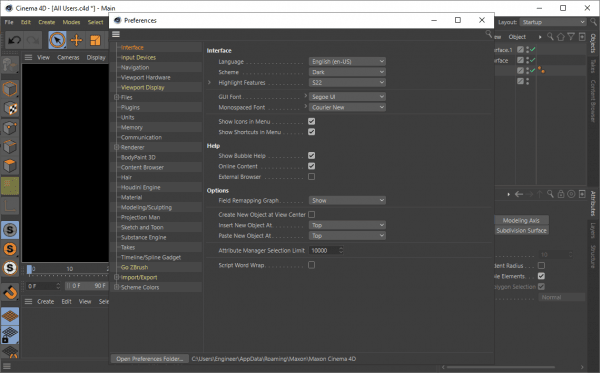
Maxon CINEMA 4D Studio 2027.0 Full Version Free Download from the link given below:

I am so happy but very surprised that this actually worked!
I’m really excited to start using this program
Is this legit?
like to try this