
Description of SQLite Expert Professional 6.0.10.712:

SQLite Expert Professional 6.0.10.712 Full Version is an advanced database management software that simplifies the development of SQLite3 databases and empowers you to view, edit, and manage almost all aspects of the database. It has an intuitive and user-friendly interface, which permits you to administer your SQL databases with better visibility into how your databases are operating. SQLite Expert Professional combines a variety of database management and maintenance tools into a single seamless environment with a user-customizable interface. The program permits users to edit and manage tables visually without writing a line of SQL, making it easy for novices and advanced users to master.
The GUI supports all the features of SQLite Expert Professional. It includes a visual query builder, an SQL editor with syntax highlighting and code completion, visual table and view designers, and powerful import and export capabilities.
SQLite Expert Professional 6.0.10.712 Key Features:
- Build complex SQL queries with ease.
- It formats the SQL query text layout.
- Powerful tools for parsing and analyzing SQL queries.
- Advanced SQL editor with syntax highlighting and code completion.
- Visual editors for table columns, indexes, foreign keys, triggers, unique constraints, and controls.
- Restructure any complex table without data loss.
- Any restructuring operation is wrapped in a nested transaction that is rolled back if any errors occur while applying the changes.
- Import data from an ADO data source, CSV files, SQL script, or SQLite.
- Export data to CSV files, SQL script, Excel, or SQLite.
- Copy tables between SQLite databases using drag-and-drop operations.
- Export data to Excel via clipboard.
- Edit the data in the grid with powerful built-in editors.
- The image editor currently supports JPEG, PNG, BMP, GIF, and ICO image formats.
- Visualize and modify BLOB fields with the built-in hex editor.
- Full Unicode support.
- Support for connected databases.
- Supports SQLite extensions and third-party SQLite libraries.
- Support for Lua and Pascal scripts.
- View all functions and mappings installed by each SQLite extension!
- Added support for partial indexes.
- Added support for tables without row ID.
What’s new in SQLite Expert Professional 6.0?
- A new Diagram page draws the whole database as an entity-relationship diagram: a box per table, view, and virtual table, and a line between the columns each foreign key joins, marked with the cardinality worked out from the keys. Show table names alone, their key columns, or every column; arrange it automatically or place the tables yourself, and the layout comes back with the file. It can be saved as a picture, exported to PDF tiled or as a single large page, and printed. A view or a virtual table is drawn in italics, with a tag naming what it is — View, or the module behind a virtual table, since fts5 says more about a box than “virtual table” would. Professional Edition.
- A file can now be imported into a table: JSON, XML, an HTML page, or a spreadsheet in ODS, XLSX, or XLS format. The destination is a new table, created from the columns the file was found to have, or an existing one, matched by name. One dialog reads all four and shows what it found before anything is written — the columns, their types and how many rows — and says whether the file stated its columns or they were worked out from the values. A file holding more than one table offers them by name. Professional Edition.
- The JSON export asks what to do with a value that is itself JSON. Written as a string, it comes out escaped, which is exactly what the column holds and reads like nothing anybody wanted; it can now be embedded in the file instead, so a JSON column reads as JSON. This covers a JSONB column and text holding a document alike. The same dialog carries the two options that were already there underneath: whether BLOB columns are included, and whether the file is formatted.
- The HTML and XML exports each write two genuinely different files, and now let you choose. The styled and formatted routes follow the grid, carrying the columns you can see, laid out as you see them; the data routes follow the dataset, carrying every column with its type — and the XML data route is the one the new import reads back.
- The export dialogs ask for the file name on the same form as the options, the way the text export always has, instead of in a Save dialog first.
- Every export can show you the file it wrote, if you ask it to: Tools → Options → Data → Open the file after exporting, off by default. A file type with nothing registered against it opens its folder with the file selected, rather than Windows’ “How do you want to open this file?” picker.
- The Options dialog has a Values page. How dates and times, booleans and GUIDs are stored moved off the Data page onto one of their own — three groups that answer the same question, and a Data page short enough to read without the dialog growing to fit it.
- Clearing an encryption key is confirmed. An empty key at the Set/Change encryption key prompt removes the encryption, leaving the file readable by anyone who has it, so it now asks first and defaults to No. It asks only where a key is actually being taken away.
- The database tree’s pop-up menu folds up: the extension commands under Extensions, and the import and transfer commands under Import/Export. It had grown long enough to run off the bottom of the screen.
- Arithmetic that overflows answers the way SQLite means it to. select 9.0e+307 * 10.0, select exp(1000.0) and an avg() over very large values each reported “Floating point overflow” instead of returning an infinity: SQLite is C, where an overflow yields infinity rather than an error, and the trap Delphi arms on every thread was catching it on the way out.
- Redesigned, rewritten help, now HTML-based, searchable and easier to read.
- Updated the SQL parser and code generation to support and take advantage of the latest SQLite features.
- Many fixes for issues uncovered by an extensive code review and a new unit-test suite.
- Lua print now behaves as it does in any other Lua interpreter: arguments are tab-separated, the line is terminated, and values of every type are rendered properly. io. write writes without separators or a newline. Older scripts that end a print with an explicit “\n” argument still work, but now produce an extra blank line.
- Fixed the scripting Output tab, which could show multi-argument print output in reverse order and silently drop repeated output.
- Fixed FileAge in Pascal scripts, which was published with a TDateTime parameter but bound internally to a different function. The date must now be received in a variable declared TDateTime; earlier versions accepted only a Double.
- Light and dark themes, with a mode picker on the toolbar. The system follows the Windows setting as it changes, and is what a new installation starts on; each mode has a theme of its own, chosen once under Tools → Options → Themes. Two new themes ship with this release: DeepWhite, which a new installation uses for light mode, and DeepBlack for dark.
- The bundled dbdemos sample database now installs under the shared application data folder rather than beside the program. Scripts that referred to the old location need their path updated.
- A new Convert to STRICT command on one or more selected tables. A STRICT table refuses values that do not match its columns’ declared types instead of converting them, so the command is a wizard that reads the data first and shows what a conversion would do to it: the type each column would take, and how many rows would be refused, kept under a different type, or come back changed. Each column is offered the type that changes nothing, and anywhere no such type exists — a DECIMAL column holding both whole numbers and fractions, for instance. Nothing is altered until the last step, which shows the SQL before running it.
- Exported data now says what a cell holds. SQLite does not enforce declared types, so a column declared INTEGER can hold the text “seven”; every export format wrote such a value as the conversion’s default instead — 0, or a zero date — and an SQL script exported that way was not a copy of the table it came from. All formats now write the stored value, and a replayed script reproduces the storage classes of the original.
- A column declared BOOLEAN holding text that is not a boolean now shows that text rather than an unticked checkbox, which stated a false value nobody had established and looked no different from a stored 0. Which text counts as TRUE and FALSE can be set under Tools → Options → Data → Boolean; the defaults are what earlier versions recognised.
- Added JSON and JSONB to the type mappings. JSONB is SQLite’s binary form of a JSON document, so a column declared JSONB is now read as a blob rather than as text, which also lets Show JSONB as readable JSON apply to it.
- A table created from data rather than from SQL — by a text import, by the transfer wizard, or by a script — now declares its text columns TEXT rather than CHAR. CHAR(n) means fixed-width in standard SQL, and these columns are not that; SQLite gives both names the same affinity, so nothing behaves differently. Existing databases are untouched.
- A blob stored in a column declared as text — which SQLite allows, and which a JSONB value in a JSON column is — used to leave an empty cell in the grid, no different from an empty string, and was dropped altogether by the CSV, TSV, HTML and XML exports. It now reads (blob) in the grid, and each format writes it the way it writes any other blob.
- An integer larger than 253 in a column read as a number — DECIMAL and NUMERIC columns keep whole numbers as integers — was shown and exported as the nearest value a floating-point number can hold: 9007199254740993 became 9007199254740992, and permanently so in an exported script. Such a value is now shown and written exactly.
Operating System:
- Windows XP
- Windows 7
- Windows 8, 8.1
- Windows 10
- Windows 11
Screenshots:

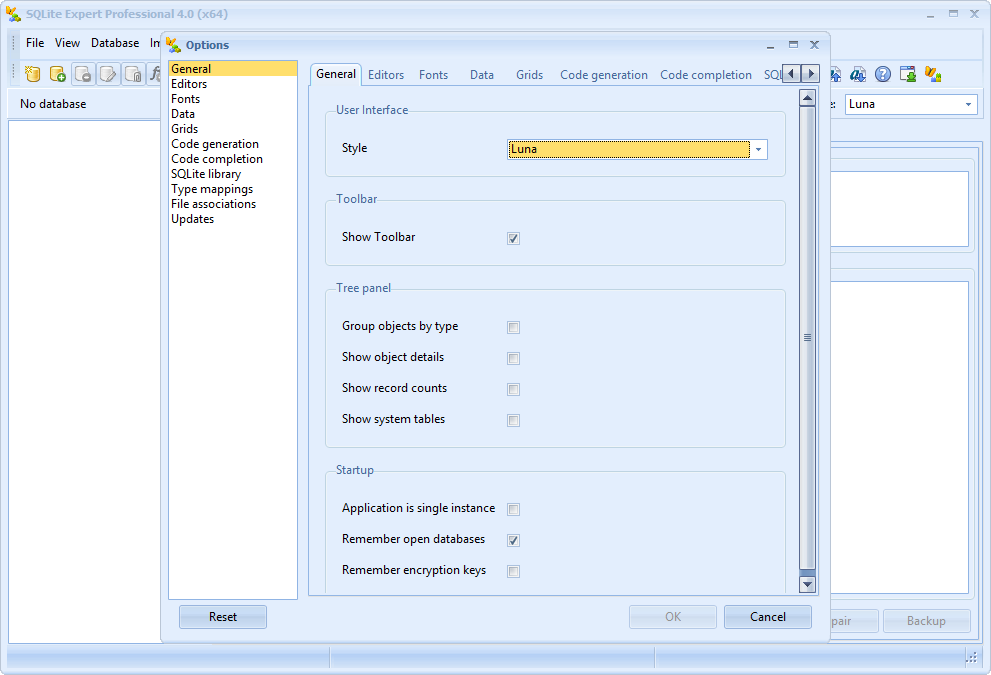
SQLite Expert Professional 6.0.10.712 Latest Version Free Download from the link given below:
