
Description of Altium Designer 26.11.1 Build 5:

Altium Designer 26.11.1 Build 5 Cracked is a popular electronics design automation software that engineers and designers use to create printed circuit boards (PCBs), field-programmable gate arrays (FPGAs), and other electronic devices. It offers various features and tools for schematic design, PCB layout, signal integrity analysis, and 3D visualisation.
Altium Designer 26.11.1 Build 5 Full Version provides a unified design environment that allows users to switch between schematic and board design easily. It also includes an extensive library of electronic components that can be easily found and integrated into projects. Altium Designer brings new features and improvements, including a new high-speed design workflow and an automated documentation workflow. This program is a complete set of tools for developing electronic products.
Altium Designer 26.11.1 Build 5 Key Benefits:
- One Tool, One Interface, One Experience: A user interface designed specifically to bring you the full power of Altium Designer.
- Share & Collaborate: Share projects and photos directly with anyone, anywhere, on any device, with powerful browsing and commenting capabilities in the browser.
- Everything in One Place: Organise all your designs, libraries, and contributors in one place. View an extended design history from component changes to layer stack modifications and easily restore and/or restore previous versions as needed.
- Native 3D PCB Design: Immerse yourself in a visually stunning and photorealistic 3D world of your designs. Interact and collaborate with mechanical designers like never before.
- Collaboration with MCAD: Initial integration with SOLIDWORKS, Creo, and Inventor ensures transparent partnerships with your MCAD peers. Forget about import/export; work like today and sync with one click.
- Realistic Rigid-Flex: Design rigid-flex in full 3D and ensure that 3D components, assemblies, and PCBs meet all mechanical requirements.
- Multiboard Assembly: The original 3D engine allows you to see how your product’s different systems come together to test compatibility and connectivity, making it easy to find and resolve issues between cards before moving on to a prototype.
- Route Your Way: Push, move, tighten, turn. Whatever the angle, look for the delay. Travel your way, faster than before.
- Most Popular ECAD Tool: Building a Challenging Future. Simplify your life with Altium Designer, the world’s top choice for designers.
Altium Designer 26.11.1 Build 5 Key Features:
-
Design Review Use Case
Design reviews are very important to success. Record project discussions using in-context comments in a web browser or Altium Designer to ensure comments are captured and processed efficiently.
-
Electronic Collaboration Use Case
Work with other engineers around the world. With Git-based version control and visual diff capabilities, you can be sure that designers are always in sync.
-
Customer Interaction Use Case
Keep your clients updated on progress by sharing design snapshots or work in progress, accessible in a web browser from anywhere and on any device.
-
Manufacturer Collaboration Use Case
Publish your manufacturing and assembly data with confidence and let your manufacturing partners view and comment on your production output directly in the browser.
-
MCAD Collaboration Use Case
Stay connected with your mechanical engineering peers while managing less and collaborating less with built-in integrations with SOLIDWORKS, Creo, and Inventor.
-
Software Collaboration Use Case
Access to the design is required to effectively debug the equipment. Embedded software developers can now search, select, and cross-reference in schematic, layout, and 3D browsers.
-
Remote Working Use Case
Remote work is no longer the exception, but the norm. Whether you’re at home, at a client’s, at the airport, or anywhere in the world, remote work has never been easier.
-
Anonymous Sharing Use Case
Experience the greatest freedom with the ability to anonymously share snapshots of your design with anyone in the world using simple links. They need access to a browser; registration is not required.
-
Embedded Viewer Use Case
Want to show your design on your blog? Integrate your design into your site with just a few lines of code, giving your users an unrivalled interactive design.
-
Unified Interface
Altium Designer has been designed from the ground up to be a unique and robust electronic application development environment that contains all the advanced design tools you need to complete your project.
-
Global Editing
Altium Designer provides flexible and powerful global editing tools. Make changes to all or some of the components at once. The universal selection tool allows you to find, filter, and modify the desired components quickly.
-
Simple and Intuitive
Altium Designer makes it easy to create multi-channel and hierarchical designs. Simplify a complex design into something visually pleasing and easy to understand.
-
Schematic-Driven Design Rules
Design starts with a diagram, so Altium Designer allows you to define high-end interfaces and their limitations in the diagram editor.
-
Hierarchical and Multichannel Design
Simplify any complex or multi-channel design into logical elements that can be managed with Altium Design’s hierarchical design tool.
-
Interactive Routing
Create the highest quality PCB configurations in no time with Altium Designer’s advanced routing engine, which includes several powerful routing options such as bypass, push, hug, obstacle ignore, and differential pairing.
-
Stackup Planning
The layer stack manager has been completely updated and redesigned, including impedance calculations, material libraries, etc.
-
3D visualization
Render and interact with your original 3D design using Altium Designer’s advanced 3D engine.
-
Variants Support
Manage multiple designs without having to create a separate project or design version.
-
Real-time BOM Management
ActiveBOM provides automation by providing information about parts, such as availability and pricing from selected suppliers, so there are no surprises.
-
Powerful Part Search
Directly host and transfer electronic components that meet design, availability, and cost requirements by searching for global parametric vendors.
-
Automated Project Release
Altium Designer offers you a controlled and automated design publishing process that ensures your documentation is easy to create, complete, and distribute well.
-
Professional PCB Documentation with Draftsman
Draftsman’s advanced features simplify PCB assembly, fabrication, and design.
-
Reusable Outputs Configurations
Create and publish your complete design in a simple, easy-to-share batch output package that can be reused within Altium Designer.
What’s new in Altium Designer 26.11.1 Build 5?
Schematic
- In some cases when attempting to add a footprint to a component from an Integrated Library, using the Footprint Manager, an Access Violation (in module “WorkspaceManager.DLL”) would be encountered.
- In a specific design, the pin parameters for a particular connector on one of the design’s schematic documents were not being displayed.
- With a hierarchical VCS-controlled project open locally and one of its remote documents also open using the History & Version Control » Open Remote Document Version command (opening that document as a free document), attempting to jump from a sheet entry to a corresponding port (or vice versa) in the local project would result in an Access Violation (in module “AdvSch.dll”) being encountered.
- The Parameter Table Editor dialog would show all objects, even when the option to include ‘Selected Objects Only’ was enabled.
PCB
- For a specific design, Online DRC failed to observe a defined Board Outline Clearance design rule, allowing track to be routed inside a clearance boundary.
- In a specific case and when attempting to open a particular PCB, the error “Object reference not set to an instance of an object” would be encountered.
- In some cases when working within a PCB document, an Access Violation (in module “Altium.PCB.DataModel.X.dll”) would be encountered.
- For a via defined with ‘Direct’ connection style to polygon pours, if that via was placed within a same-net hatched polygon pour (set to ‘Pour Over All Same Net Objects’), but did not touch any of the pour’s hatching tracks, it was electrically unconnected, resulting in an Un-Routed Net rule violation. This release enhances support for when a pad/via is placed inside a hatched polygon pour of the same net but in a way that it does not touch tracks of the polygon pour. Now, connection is made to the nearest tracks of the polygon pour using additional tracks. (Requires the PCB.Polygon.AdvancedPour advanced settings option to be enabled).
- When viewing a PCB in 3D Layout mode, double-clicking on a component (with an associated 3D body) and choosing to select the component from the pop-up selection window, would always result in the 3D body being presented in the Properties panel, rather than that component.
- When interactively routing with the Auto Shrinking option enabled and routing Width set to its maximum value, the track would not observe constraints defined in the Board Outline Clearance design rule.
- In some cases when working with a PCB in 3D Layout View mode, an Access Violation (in module “NvPresent64.dll”) would be encountered.
- In some cases when attempting to save an older format PCB document into a later format, the error “EIntfCastError: Interface not supported…” would be encountered.
- In a specific design and with the PCB.Polygon.AdvancedPour option enabled (Advanced Settings), repouring all polygon pours, then closing the PCB without saving changes, would result in a silent crash of Altium Designer.
- In some cases when attempting to merge detected differences when using the PCB CoDesign feature, the error “object reference not set to an instance of an object” would be encountered.
- In some cases when moving/editing design primitives in such a way as to cause a design rule violation, an Access Violation (in module “ADVPCB.DLL”) would be encountered.
- Where keepout track passed through a hatched polygon pour and the applicable Clearance rule for was set to zero, attempting to repour would result in only partial repour of the polygon.
- In some cases, with the PCB.Polygon.AdvancedPour option enabled (Advanced Settings) and after performing an interactive process such as routing through a polygon pour, repouring of polygon pours would not work on the first attempt.
- When removing teardrops from selected pads within the area of a polygon pour cutout and with the Objects option set to ‘Selected only’, teardrops for other, non-selected pads within the cutout, were being incorrectly removed.
- For a specific PCB, and where the ‘Pad Vertices’ and ‘Pad Edges’ options were enabled (‘Objects for snapping’ region of Board Options) and placed pads existed on the Multi-Layer with pad size (X/Y dimensions) = 0 and Hole Size = 0, a memory leak was experienced, with memory usage for Altium Designer continually increasing during PCB editing and retained until the software was completely restarted.
- For a PCB library component with donut-shaped pads defined for its Top and Bottom layers, flipping the component from Top to Bottom layer during placement from the library (or placing from the library directly onto the Bottom layer) would result in the X-Size and Y-Size values for the Bottom layer pads incorrectly becoming the same as those defined for the Top layer.
- When deleting a polygon pour using the Polygon Pour Manager dialog, whatever was under the ‘Delete’ command ,on the dialog’s right-click context menu, was being erroneously acted upon. If the Delete command was over another polygon entry, that polygon was also being incorrectly deleted (in addition to deleting the correct one). If the Delete command was over a layer heading entry, an Access Violation (in module “ADVPCB.DLL”) would be encountered.
- In some cases, with the PCB.Rendering.DrawArcBaseGeometry option enabled (Advanced Settings) and for a PCB library containing a footprint model with placed graphics (e.g., a defined company logo), the 3D view of the footprint model was not able to be rendered in the Components panel, resulting in an Access Violation (in module “ADVPCB.DLL”) being encountered.
- With Windows system locale (in Region Settings) set to ‘Chinese (Simplified, Mainland China)’ and the ‘Use localized resources’ option enabled on the System – General page of Preferences, restarting Altium Designer and attempting to open any PCB document would result in an Access Violation (in module “ADVPCB.DLL”) being encountered.
- Attempting to edit the physical nets for a PCB, through the Configure Physical Nets dialog, would result in an Access Violation (in module “ADVPCB.DLL”) being encountered.
- With the PCB.Polygon.AdvancedPour option enabled (Advanced Settings) and in a design featuring a board region with added stiffener, adding coverlay would incorrectly create ‘Zero Area Polygons’, with the coverlay not visible with the board in 3D View nor included in generated fabrication files.
Constraint Manager
- In some cases when creating differential pairs from xNets, it was possible to create a duplicate xNet differential pair, resulting in the error “An item with the same key has already been added…” being encountered.
Wire Bonding
- Wire bonding was not being displayed correctly in the Board Section View, Component View and Board Isometric View of a Draftsman-based manufacturing drawing document (*.PCBDwf).
Harness Design
- In some cases, the Layout Drawing view was not visible after importing changes from a harness design’s layout drawing into its harness manufacturing drawing.
- For a specific harness design, attempting to import changes into the harness manufacturing drawing from the underlying layout drawing would result in the error “System.ArithmeticException: Function does not accept floating point Not-a-Number values” being encountered.
Platform
- In some cases when viewing a browser-related element within Altium Designer using WebView2 (e.g., the Home page), the error “System.Runtime.InteropServices.COMException: The object invoked has disconnected from its clients…” would be encountered.
- For users of the extensions ‘EMI Design Rule Checker’ or ‘Plane Resonance Analyzer’, attempting to launch those features from the main menus in a PCB document would result in termination of Altium Designer.
- Where multiple users are using the same computer, only the user who originally installed Altium Designer would be able to start it successfully. Other users would encounter the error “Runtime Error 217”.
- With the UI.ProjectOptions.SearchPaths option enabled (Advanced Settings) and having added a search path to the Search Paths tab of the ‘Options for Project’ dialog, clicking on the Refresh List button would result in the error “Type ‘Altium.WorkspaceManager.DataModel.SourceDocumentAdapter’ has a ComVisible(false) parent…” being encountered.
- Additional ‘Third Party’ notices, that were removed from the Copyright notices dialog in Altium Designer 26.10, have been added back in this release.
Data Management
- In some cases while working with the Project Releaser, an Access Violation (in module “ProjectReleaser.dll”) would be encountered.
- It was not possible to rename a harness wiring model through the Component editor, when configured in its Single Component Editing mode. In some cases, the preview of the model would also disappear.
- When placing a comment in a document of a design that had been shared and assigning it as a task to a specific user, the task was being created without the assignee.
- After sharing a Workspace project with an external user (not a member of that Workspace) and adding a task (assigned to them) through the browser interface, that task was not displayed for them in Altium Designer’s Comments and Tasks panel (after opening the ‘Shared With Me’ project) unless they were connected to the Workspace.
- When creating a new Jira Issue from a placed comment, ‘(optional)’ labels have been added to better indicate which fields (Description and Assignee) are optional.
- When releasing changes to a Workspace model into a new revision, you now have the ability (for those with assigned operational permission) to preserve the current lifecycle state for associated Workspace components that reference that model. The current lifecycle state of the model itself is no longer preserved. Note that this applies only to a Workspace on the Altium Platform.
- It was not possible to paste fractional values into existing template-sourced parameters, when editing components in the Component editor (in its Batch Component Editing mode). Such values would be rounded to the nearest integer value.
- Defined process-based workflows for a connected Workspace, available from the Project Activities and Project Releaser sub-menus, were not being updated when switching between connected Workspaces, resulting in the error “Process definition not available”, when attempting to invoke them.
- When releasing a component or design project into a connected Workspace for the first time and creating the related item(s) in that Workspace, a CMD script is no longer run in the temporary folder (e.g., C:\Users\<UserName>\AppData\Local\Temp) to create a Zip (using 7za.exe) of those items for upload to the Workspace.
- When releasing a design project using the Project Releaser, it was incorrectly possible to get into a state where existing data for a previous release (e.g. Fabrication data set) was being modified with that of a later release.
- Enhanced the filtering controls in the Comments and Tasks panel. The default filtering state is for all types to be enabled (Comments, Tasks and Jira Issues), the scope (‘Current document’; moved from the settings window) to be disabled and all assignees (assigned tasks or Jira issues) to also be disabled. The filter button will now turn blue only if the filtering state is not the default. In addition, a ‘Clear Filters’ control is available to quickly return filtering to its default state.
- Added the ability to copy-paste system parameters when editing a component template, with the ability to paste between template documents.
- When using the Component editor in its Batch Component Editing mode, and where a defined component uses parameters to define its Name and/or Description, making a copy of that component now keeps the use of those parameters in the Name/Description fields for the new component, instead of plain text.
- When defining operation permissions for a connected Workspace (through the Edit Operation Permissions dialog), it was not possible to add the ‘Workspace Members’ entity back, if removed from a particular operation type.
- When using the Operations » Export Grid command with selected components in the Explorer panel (in Classic View or Components View) and the ‘Show only latest’ option is enabled, only the latest revisions of those components will now be exported and not all revisions, as was the case previously.
- When configuring a Bill of Materials report (direct or through an OutJob), attempting to modify filtering through the Filter Editor dialog would lead to the error “Object reference not set to an instance of an object” being encountered.
Import/Export
- When importing a KiCad version 9 or 10 design file, layer mapping was incorrect, with mechanical layers being mapped to signal layers.
- When importing a KiCad version 10 design file, net information was not being imported, resulting in copper primitives set to ‘No Net’.
Operating System:
- Windows 7
- Windows 8, 8.1
- Windows 10
- Windows 11
Screenshots:
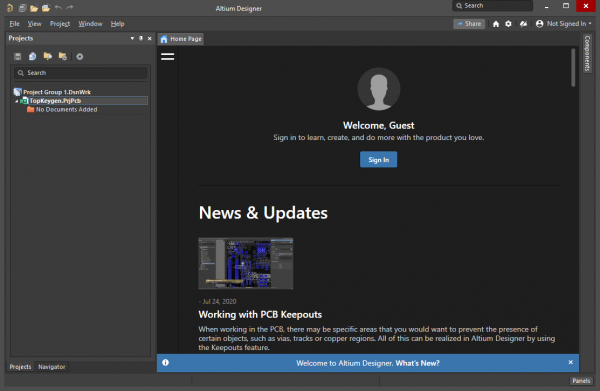

Altium Designer 26.11.1 Build 5 Full Version Free Download from the link given below:
